The Science of Food Tracking: Why It Works, Why People Quit, and How We Fixed It
Food tracking is one of the most heavily researched tools in all of behavior change — and one of the most abandoned. The science says both facts are true for the same reason.
July 25, 2026 · 10 min read

If I could hand every client exactly one habit and nothing else, it wouldn't be a diet, a supplement, or a workout split. It would be this: know what you actually eat. Not what you think you eat. What you actually eat.
That's not a coaching opinion — it's one of the most consistent findings in the entire scientific literature on weight change. And yet the same literature shows most people abandon food tracking within weeks. This post is about both halves of that story: why tracking works so well, the human psychology of why almost everyone quits, and how we built the app my clients use specifically to attack the quitting part.
Part 1: The Evidence That Tracking Works
Keeping a food record can double your results
The landmark study here is the Weight Loss Maintenance Trial — nearly 1,700 adults, published by Hollis and colleagues in the American Journal of Preventive Medicine (2008). The single strongest predictor of weight loss was how many days per week participants kept a food record. Those who logged daily lost roughly twice as much weight as those who didn't log at all. Not a different supplement. Not a special diet. A record.
That wasn't a one-off. A systematic review by Burke and colleagues in the Journal of the American Dietetic Association (2011) looked across the self-monitoring literature — food diaries, activity logs, regular weigh-ins — and found a consistent, significant association between self-monitoring and weight loss across studies. And a 2019 study by Harvey and colleagues in Obesity tracked logging behavior day by day and found the people who lost clinically significant weight weren't the ones who tracked perfectly — they were the ones who tracked consistently, even imperfectly.
Why it works: you can't steer a ship without instruments
In a classic study published in the New England Journal of Medicine, Lichtman and colleagues (1992) examined people who reported they "couldn't lose weight despite eating almost nothing." When intake was measured objectively, participants were under-reporting what they ate by an average of 47% — and over-reporting their activity by about 51%. They weren't lying. Human memory and perception of food intake are just genuinely, reliably terrible.
This is why "I barely eat and can't lose weight" and "I eat so much and can't gain weight" are usually the same problem in opposite directions: no instruments. Tracking doesn't change your metabolism. It replaces a guess with a measurement — and every decision you make downstream gets smarter.
The psychology: measurement changes behavior by itself
Psychologists have known for decades that the act of observing your own behavior changes it — self-monitoring is the first step in Bandura's model of self-regulation, and it's why simply writing down what you eat, before any diet rules exist, tends to improve what you eat. There's a feedback loop in your head: observe, compare to your goal, adjust. No observation, no loop.
The strongest evidence for this comes from a meta-analysis by Michie and colleagues in Health Psychology (2009), which analyzed 122 behavior-change interventions to find which techniques actually moved the needle for healthy eating and activity. The winner, by a clear margin: self-monitoring combined with feedback on that monitoring. Tracking alone helps. Tracking that something — or someone — responds to helps far more. Hold that thought, because it's the core of what makes our setup different.
Part 2: Why Everyone Quits Anyway
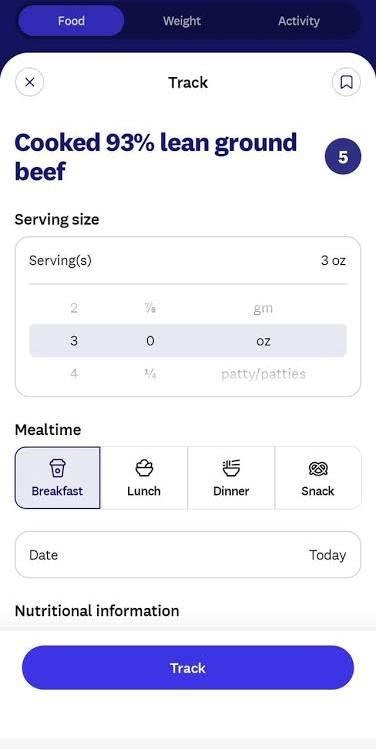
If tracking is this effective, why does almost everyone stop? Research on commercial tracking apps shows steep abandonment — in a study by Carter and colleagues in the Journal of Medical Internet Research (2013) comparing tracking methods head to head, adherence was the whole ballgame: the group with the lowest-friction method (a smartphone app, at the time) logged significantly more consistently than the paper-diary and website groups. The tool that's easiest to use wins — not the most accurate one, not the most feature-rich one.
Every step between "I ate" and "it's logged" costs you users. Traditional calorie apps stack those steps high:
- Search costs. Type the food, scroll through dozens of near-identical database entries, half of them user-submitted and wrong.
- Estimation costs. Was that 150g of rice or 300g? Cooked weight or dry? A "serving" or a Franco-sized serving?
- Decision fatigue. Behavioral research is clear that every added decision drains the willpower you were saving for the actual eating choices.
- The perfectionism spiral. Miss two days, feel behind, declare the week ruined, quit. (The research above says imperfect-but-consistent beats perfect-but-brief every time.)
- Nobody's watching. The app doesn't care. There's no feedback on the other end — which, per Michie's meta-analysis, is exactly the ingredient that separates the best interventions from the mediocre ones.
Habit science explains the stakes here. Lally and colleagues (European Journal of Social Psychology, 2010) followed people forming real-world habits and found automaticity takes about 66 days on average to build — and forms fastest when the behavior is easy and consistently repeated. A tracking method with high friction never survives long enough to become automatic. One that takes seconds does.
Part 3: How We Built Around the Quitting Problem
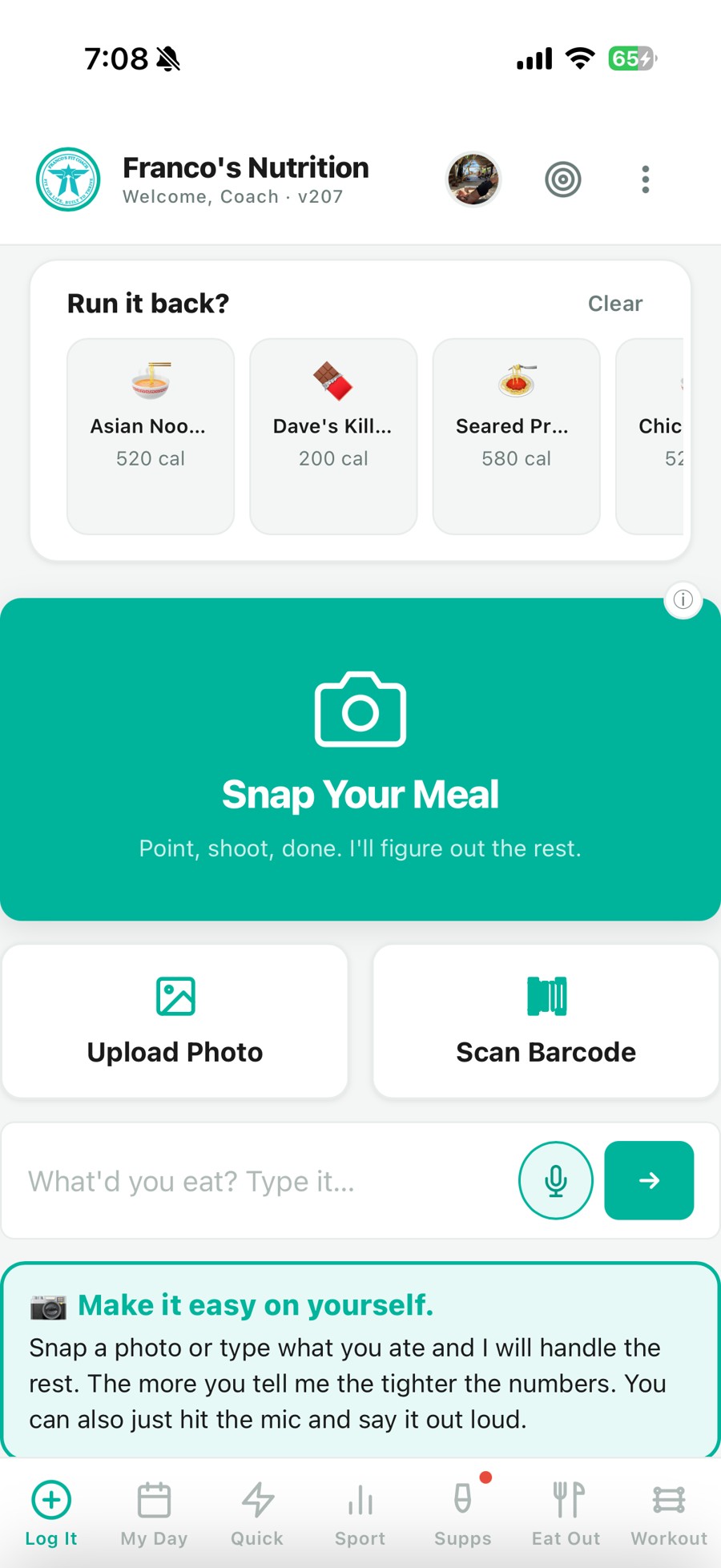
When I built the nutrition app my coaching clients use, I didn't start from "what features can we add." I started from the abandonment research: what would tracking look like if quitting were the enemy? Four answers came out of that, and each one maps directly onto the science above.
1. A photo instead of a search bar
You photograph your plate. AI analyzes it and returns the breakdown — calories, protein, carbs, fat — in seconds. No database spelunking, no portion guessing, no forty versions of chicken breast. This is the Carter finding applied ruthlessly: the lowest-friction method wins because it's the one still being used in week six. Logging a meal takes less time than unlocking most calorie apps.
2. Feedback that actually responds to your data
Remember the Michie meta-analysis: self-monitoring plus feedback is the most effective combination in the behavior-change literature. Your log builds a daily optimization brief — what's working, what's drifting, what to adjust today — so the data loops back into decisions instead of piling up in a graveyard of entries.
3. A human on the other end
This is the part no commercial app can copy: I actually see my clients' data. When your logs drift, I notice and we adjust — before a bad week becomes a bad month. Accountability to a real person is one of the oldest effects in coaching research, and it's the difference between an app that watches you and a coach who's watching out for you. MyFitnessPal doesn't text you back.
4. Built for imperfect humans
The Harvey study found consistency beats perfection — so the app is designed for the missed meal, the restaurant plate, the chaotic Tuesday. Log it late, log it roughly, just log it. The system optimizes around real data from a real life, because that's the only kind of data that survives 66 days and becomes a habit.
Tools That Make Tracking Even Easier
Two low-tech companions do a lot of heavy lifting alongside the app. Prepped meals in clear containers make half your week's logging automatic — same meal, same breakdown, zero thought. And for the times you want precision (protein portions especially), a food scale turns guessing into knowing in five seconds.
Recommended — Glass Meal Prep Containers
Prep once, log once, repeat all week. Identical meals are the easiest meals to track — and glass keeps them fresh and reheatable.
Glass Meal Prep Containers — make half your logging automatic →Recommended — Digital Food Scale
The five-second upgrade from guessing to knowing — especially for protein portions, where eyeballs are least reliable. Waterproof stainless top, rechargeable.
Digital Food Scale — precision when you want it →The Bottom Line
The research is unambiguous: people who track what they eat lose roughly twice as much weight as people who don't, the benefit comes from consistency rather than perfection, and tracking works best when the data gets feedback — ideally from a human. The research is equally unambiguous about why people quit: friction.
So the answer isn't to try harder with a tool built to be abandoned. It's to use one built around how humans actually behave: photo in, breakdown out, a system that optimizes around your real life, and a coach who sees the data and adjusts with you.
The app is part of how I coach — every online client gets it as part of working with me. If you want the instruments and the pilot, that's exactly what coaching is.
Want the app and the coach behind it?
The nutrition app comes with my online coaching — photo logging, daily briefs, and me watching your data so you don't have to figure it out alone.
Book a Free CallReferences
- Hollis JF, et al. Weight loss during the intensive intervention phase of the Weight Loss Maintenance trial. Am J Prev Med. 2008;35(2):118–126.
- Burke LE, Wang J, Sevick MA. Self-monitoring in weight loss: a systematic review of the literature. J Am Diet Assoc. 2011;111(1):92–102.
- Harvey J, et al. Log often, lose more: electronic dietary self-monitoring for weight loss. Obesity. 2019;27(3):380–384.
- Lichtman SW, et al. Discrepancy between self-reported and actual caloric intake and exercise in obese subjects. N Engl J Med. 1992;327(27):1893–1898.
- Michie S, et al. Effective techniques in healthy eating and physical activity interventions: a meta-regression. Health Psychol. 2009;28(6):690–701.
- Carter MC, et al. Adherence to a smartphone application for weight loss compared to website and paper diary. J Med Internet Res. 2013;15(4):e32.
- Lally P, et al. How are habits formed: modelling habit formation in the real world. Eur J Soc Psychol. 2010;40(6):998–1009.
Ready to Take the Next Step?
Book a free strategy call. We'll figure out what your body needs and whether live training is a fit.
Book Your Free Strategy CallPrefer to start in writing? Fill out the intake form
Keep Reading
You Think You're Hungry But That Might Just Be Boredom Stress Or Habit
Most people do not overeat because they are hungry. They overeat because they are uncomfortable. Learn The Franco System for controlling cravings and separating real hunger from emotional noise.

"I Eat So Much But I Can't Gain Weight" The Truth No One Told You
You say you eat a lot but the scale does not move. The truth is you are probably under eating and under progressing. Here is the real fix.

Sleeping with the Enemy: How to Stay Fit When Your House is a Bakery
Learn how to maintain your fitness goals when living with people who have different eating habits. Practical strategies for coexisting with food 'saboteurs.'